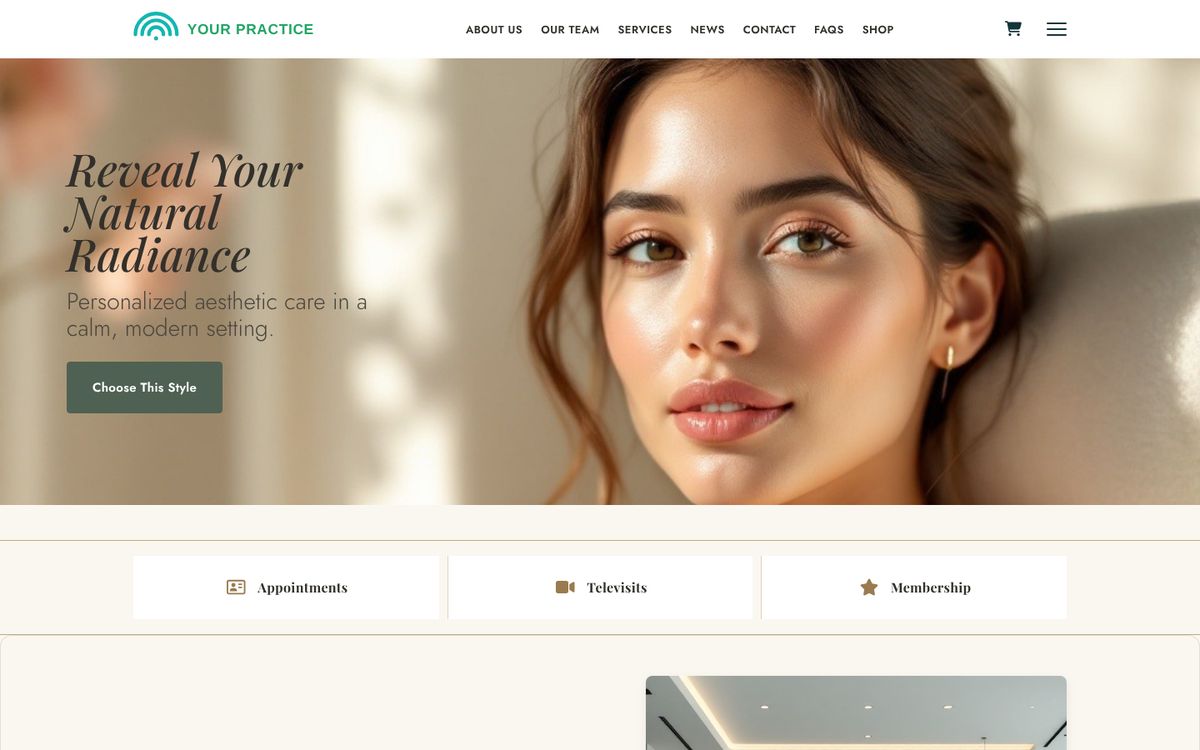
A med spa website has one job: turn the interest you earn on Instagram, in Google Maps and by word of mouth into a booked consultation. Most med spa websites are built to look beautiful and then stop. Here is what a med spa website needs in 2026 to actually convert — seven things, in the order a prospective client meets them.
Short answer: a clear treatment menu with prices or price ranges, a booking or consultation request on every page, a before-and-after gallery with written consent behind every image, fresh reviews, a site that loads fast on a phone, HIPAA-aware hosting if you collect health information, and a design that looks like the experience you sell.
1. A treatment menu people can actually read
Clients arrive knowing the treatment they want — “lip filler,” “laser hair removal,” “microneedling” — not your brand names for it. Each treatment needs its own page or section with the plain-language name, who it is for, what a session involves, downtime, and either a price or a range. Pages named for the treatment are also the pages Google ranks for “[treatment] near me” searches, so one page per treatment is both a conversion and a search decision.
Two rules keep the menu honest and safe: describe outcomes as what the treatment is designed to do, not as a promise, and keep medical claims to what your supervising provider will stand behind. A treatment page is marketing copy, not clinical advice, and your website should say so.
2. Booking or a consultation request on every page
The single biggest leak in med spa websites is a “Contact us” form at the bottom of one page. Every treatment page needs a visible next step: book, or request a consultation, with the treatment pre-selected. Online scheduling is now an expectation rather than a feature; our guide to online scheduling for practices covers the data behind that expectation.
You do not need a fully automated calendar on day one. A request flow — the client picks a treatment and a preferred time, your front desk confirms — captures the intent while it is hot and keeps your team in control of the schedule. That is how appointment requests work on Clinical Media Hub's Growth and Complete plans: the client requests injectables, laser treatments or facials online, and your team confirms in the dashboard.
3. A before-and-after gallery — with consent behind every image
Results sell aesthetics. A gallery is the page clients spend the longest on, and the one most med spas get legally wrong. If your med spa is covered by HIPAA, a client's photo used to market your services is a marketing use of protected health information and requires the client's prior written authorization (45 CFR 164.508). Even where HIPAA does not apply, state medical boards and consumer-protection rules expect written consent and truthful, unaltered images.
Practically: a signed photo/media release before anything is published, no identifying details in captions, same lighting and angle in both images, and the ability to take an image down the day a client asks. If the gallery lives on your website, the images should be stored encrypted. On Clinical Media Hub, a public before-and-after gallery is part of the Complete plan, images are stored encrypted at rest, and the media release is one of the intake forms you can turn on.
4. Reviews, fresh and visible
Patients read reviews before they choose a provider — 84% do, and 51% read at least six first (rater8, survey of 1,008 U.S. patients). Consumers increasingly want a 4.0+ rating and at least 20 reviews before they will consider a business (BrightLocal, 2026). For a med spa, where the purchase is elective and visual, reviews carry even more of the decision.
Your website should show your current Google rating and recent reviews, and your operation needs a steady, consent-based way to ask for new ones. One warning that applies to every med spa: when you reply to a review, never confirm the reviewer is a client or mention a treatment — that is the mistake behind real HIPAA enforcement actions. Our local SEO data guide walks through the review rules and the safe reply pattern.
5. Instagram-grade visuals, phone-first speed
Your prospective client found you on a phone and will judge your website on a phone. Google ranks the mobile version of your site, and the “good” Core Web Vitals thresholds — largest contentful paint under 2.5 seconds, interaction to next paint under 200 ms, layout shift under 0.1 — are the bar. Heavy hero videos and uncompressed photos are the usual reasons a med spa site misses it.
Design matters as much as speed in this specialty. A med spa site should look like the experience: calm, polished, premium. That is why we designed Clinical & Modern Med Spa specifically for aesthetics practices, with Elegant & Aesthetic as a softer alternative — and every design on the platform works for every specialty, so the look is your choice.
6. HIPAA-aware hosting, if you collect health information
Does HIPAA apply to a med spa? It depends on how your practice bills and what it collects, and the answer is for your attorney. What is certain is that the moment your website collects health history, consent forms or consultation requests with medical detail, you want that data handled on HIPAA-aware infrastructure with a signed Business Associate Agreement from your website vendor. No vendor can certify your practice — HHS certifies no one — but a vendor that will not sign a BAA is a vendor to avoid. What HIPAA-aware hosting really means explains the difference.
On Clinical Media Hub every plan includes HIPAA-aware infrastructure and a BAA you sign in your dashboard, and your med spa runs in its own application service and database rather than on a shared website host.
7. Content that keeps you visible between visits
Aesthetics clients return on a cycle — three months for neurotoxin, longer for laser and filler. A website that publishes a short post about seasonal skin care, a new treatment or a membership keeps you in front of them between appointments and gives Google fresh pages to index. Organic social does the same job on Instagram and Facebook; it builds the trust clients act on later, which we unpack in growing your practice with organic Facebook and Instagram.
The constraint for a busy owner is time, which is why Clinical Media Hub drafts the posts and articles for you and publishes only after you approve them: Growth publishes up to 8 social posts and 1 article a month, Complete up to 12 and 4.
Med spa website checklist: one page per treatment · booking or consultation request on every page · gallery with a signed release behind every image · current rating and reviews on the site · passes Core Web Vitals on a phone · HIPAA-aware hosting with a BAA · a design that looks like the experience · something new published every month.
See how this looks on a real design: websites and marketing for med spas, from $179/month billed annually, with a 7-day free trial and plans you can compare before you subscribe.
Frequently asked questions
Does a med spa website need to be HIPAA-aware?
If your website collects health information — intake forms, consultation requests with medical detail, consent forms — HIPAA may apply, and you want HIPAA-aware hosting with a signed BAA. Whether HIPAA applies to your practice as a whole is a question for your attorney.
Can I post before-and-after photos on my website?
Only with the client's written consent, and if your practice is covered by HIPAA that consent must be a HIPAA authorization, because marketing with a patient's image is a marketing use of protected health information. Keep captions free of identifying detail and remove images on request.
Should treatment prices be on the website?
A price or a range answers the first question most clients have and filters consultations toward people ready to book. If pricing varies by provider or area treated, publish a “from” price and explain what changes it.
Do I need online booking or is a consultation request enough?
A request flow where the client picks a treatment and a preferred time and your team confirms captures the intent without giving up control of the schedule. Fully automated booking is a later upgrade, not a day-one requirement.
Sources: eCFR 45 CFR 164.508 (marketing authorization); rater8, “How Patients Choose Their Doctors” (1,008 U.S. patients, Dec 2024); BrightLocal Local Consumer Review Survey 2026; Google Search Central (mobile-first indexing); web.dev Core Web Vitals thresholds. Plan facts as published at clinicalmediahub.com/plans.
Ready to grow your practice's online presence? Explore plans and start your 7-day free trial.